
Saturday Showdown Roller Derby Double Header on June 23
Posted on June 19, 2018
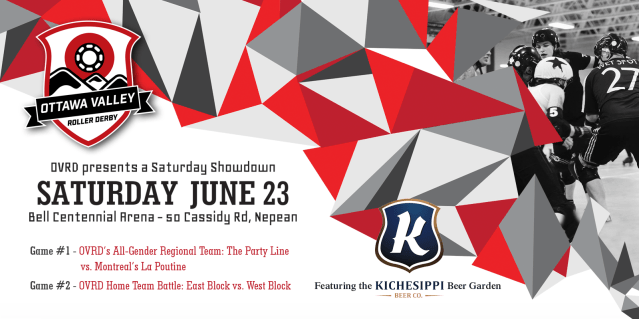
OVRD presents a Saturday Showdown Double Header of full-contact flat-track roller derby featuring our amazing Kichesippi Beer Garden!!! That’s right, this is a family-friendly and a licensed event. Feel free to bring your camping chairs into the Kichesippi Beer Garden and your I.D. to partake in the fine local craft beer available for purchase.
Doors: 5:30pm / Game #1: 6pm / Game #2: 8pm
Where: Bell Centennial Arena (50 Cassidy Rd, Nepean)
Tickets: Admission is $10 available only at the door (Kids 10 and under get in free. Limit 2 kids per adult, please)
Game #1 – OVRD’s All-Gender Regional Team: The Party Line vs. Montreal’s La Poutine
Game #2 – OVRD Home Team Battle: East Block vs. West Block
RSVP on our Facebook Event and share with your friends: https://www.facebook.com/events/185612528738246/
Meet the Officials
Posted on May 23, 2018
The family that NSOs together… a closer look at the people who make roller derby happen by Kim Slambell
Here are two facts about roller derby:
- It takes a lot of people to run a game. With a dozen non-skating officials (NSOs) in addition to all the on-skate referees, volunteers are essential.
- It takes a lot of time to be a player. Practices, games, pitching in to help the league run and grow. It’s quite a time commitment.
Here is how the four members of the Reilly family deals with those two facts.

Ann Reilly, who currently skates with OVRD under the name Ann McCrashery, has been playing roller derby in various Ottawa leagues for years. Her husband Nick, son Isaac, and daughter Kate would go watch her early bouts, and Nick noticed a problem.
Nick: They didn’t have a proper scoreboard. They were trying to do the scores on the hockey scoreboard…
Ann: Which only goes up to 99…
Nick: So you’d have one team 75, one team 53, but which one’s got the hundred in front?
Ann: Or two hundred, or three hundred.
Nick: Sometimes they’d do it just writing it on a white board and holding it up, but you can’t see that across the room.
Ann: And you can’t see the timing, so you don’t know where in the jam you are, or where in the game.
So Nick took up the cause.
Nick: I looked around at what it took to do a scoreboard and found it was just a program on a laptop. It’s free software. You just download it. The Carolina Rollergirls developed it, and it seems to have taken off and now WFTDA uses it at all their tournaments.
So you were just sitting in the audience and thinking, “This isn’t good enough.”
Nick: Yes. “This isn’t working, I don’t know what’s going on,” and then I thought, “Hey, I can help out.” It took a little while to find a projector…
Ann: We got the projector, someone came up with a screen, we put that together. And then, because our kids were there anyways, and Isaac’s good with numbers and things…
Nick: He was getting bored watching the bout, so I said, “Okay, come and score catch,” and so he did.
Ann: It’s always the same people you get as volunteers, it’s always friends and family, but not everybody wants to do it because they want to watch their friends and family play. So you’re always trying to scrounge up volunteers. So Isaac came in and helped us out, and he’s been doing it ever since. It’s gotten to the point where he doesn’t really want to watch, he just wants to officiate. He started three years ago and now Kate’s the same age as he was when he started, so we said, “Do you want to give it a try, too?” They can’t actually do sanctioned games because WFTDA has an age [minimum], but they get a chance to come and help out, and that gives them access to the potluck, so it’s a win-win situation for all of us. It’s great for me because the more involved they are, the less I feel guilty about running away from them all the time.
Nick: The first year you were playing with [former league Rideau Valley Roller Derby], I said I’d NSO the games you weren’t playing, but then…
Ann: He doesn’t care anymore.
Nick (laughing): I’ve seen enough.
When OVRD was looking for a head NSO this year, Nick stepped up. He described the 12 different NSO positions.
Nick: On the score table, there’s the scoreboard operator plus the two scorekeepers. The scorekeepers are being fed the points from the two jammer refs. The non-skating officials are really just recording what’s going on; it’s the refs that have the power and are making decisions. The scorekeepers feed into the scoreboard, and the scoreboard’s also doing timing, plus there’s the jam timer in the middle who’s starting, stopping jams and timeouts, things like that. Then you’ve got three NSOs in the penalty box as well, one timing each team, and the penalty box manager does the jammers if a jammer’s in the penalty box. And then you’ve got three NSOs in the middle of the track. The penalty wrangler is catching what the refs are saying, the penalty tracker is writing it down on a sheet of paper, and then the inside whiteboard person is writing it up on the white board. And then there’s the two lineup trackers, who are tracking who’s going out on each line: blockers, pivot and jammer.
Ann: And then when you put the paperwork in, you can break down all the statistics as well. You said in the first game last week, I skated in 46% of jams, stuff like that.
Nick: You can drill right down into it.
So what do all these NSOs actually do?
Nick: I’ll run you through a jam. Before the five-second warning, the scorekeepers will help try and spot the jammer numbers, and, as the scoreboard operator I’ll put those in, and then their names come up on the scoreboard. When the jam timer blows the whistle and points, I start the clock to start the jam, and we’ll all watch for the lead jammer, which is two whistles. One whistle is a penalty, and sometimes you’ll see a jammer coming out the front and you’ll see one whistle for “cutting” rather than two whistles for “lead.” The people who invented the derby rules, they must have some sort of love for whistles. There’s so many whistles going on all the time.
The jammers are out of the pack. Now what?
Nick: As soon as one jammer gets the lead, I’ll put that up on the board, and then the jammer refs will start feeding in points on each pass. Each scorekeeper is paired with a ref…
Ann: And they have a colour on their wrist…
Nick: And the scorekeeper has a matching wrist band. What happens is the jammer ref will hold up the points, say four points, and then their scorekeeper holds up four back to them and then the jammer ref says, “Yes, you’ve got it right” and then at that point the scorekeeper writes it down and tells the scoreboard operator. The scoreboard operator doesn’t actually deal with the jammer refs. The scorekeepers deal with that because the jam could be called off at any point, so the scoreboard operator’s got to be ready to stop the jam, which automatically starts the lineup timer for the next one.
Ann: But sometimes it can go back and forth. The jammer ref might hold up “Three!” and then the scorekeeper might hold up “Two?” because they can’t see the thumb or something, and then they’ll be like, “No, three” and it’ll go back and forth to make sure.
Nick: The problem often comes at the end of the jam. Sometimes a jammer ref’s not entirely sure if a player cleanly passed somebody just before the whistle went, and so they’ll check with one of the outside pack refs who perhaps had a better view. The problem is whilst that’s going on, the thirty second countdown to the next jam is running, but they’ve got to have their chat. That can take five, ten seconds, and then they pass the points to the scorekeeper, the scorekeeper’s got to receive the points, write it down, tell the scoreboard operator, and at the same time we’re trying to get the new jammer numbers into the scoreboard and then it’s the five-second warning…
It can be hectic is what you’re saying.
Nick: Between jams is pretty intense. As a scoreboard operator, the one time you really get to watch the game is the initial pass until somebody gets lead. There’s also communication between the penalty box and the inside whiteboard. When you’re an NSO in the penalty box, you’re tracking not only the time but also how many penalties everybody has, whether somebody’s about to foul out. Any time there’s any sort of stoppage in play, you’re going to sort of check your paperwork across between the inside whiteboard and the penalty timers to make sure they both have the same number of penalties.
Ann: Everything you’ve always wanted to know about NSOing! Also, ahead of time, all the NSOs and refs will go into the change room together and they’ll all introduce themselves…
Nick: Run through who everybody on the crew is and what they’re doing…
Ann: They’ll match up scorekeepers with jammer refs…
Nick: Identify any concerns with where stuff’s located…
Ann: There was that one game where there was a dog in turn two, there was a children’s area in turn four, and the VIP area was in turn three, so there were drunk people sitting in chairs watching, so just… be careful.
Dogs, kids, drunk people. Jammers, pivots, blockers. Seven refs, twelve NSOs. Four Reillys.
Meet the All-Stars Captains
Posted on May 22, 2018
OVRD skater and newsletter editor, Kim Slambell, sat down with the co-captains of OVRD’s WFTDA Charter team: the All-Stars. Listen in as Magi Reyes (Reyes, #16) and Robyn Bishop (Nerdie Birdie, #1812) discusses their derby histories and the team’s 2018 season.

Kim Slambell: Let’s start with your plans for the team in the upcoming season.
Robyn Bishop: First thing is to get the Code of Conduct done. There’s already a league Code of Conduct, but this one’s for the team.
Magi Reyes: I think, generally, the all-star team is a more high-stress situation, so you have to lay down ground rules. We also travel, so like if I say I’m going to be there at 6 o’clock, I don’t show up at 9:30. You would think it would be common sense, but it’s not always, so you just write it down, and people sign it and say “okay.”
RB: The goal is just to do the best that we can do; try and manage two teams coming together the best we can.
KS: Is it going well?
RB: So far.
MR: Everyone’s on their best behaviour right now…
RB: What’s it called? We’re in the forming stage. There’s actually a whole sequence of phases. It’s forming, storming, norming, performing. You go through being nice, then you start fighting, and then you get over the fighting and you start naturalizing, being normal, and then you start being cohesive.
MR: I think we need to force that fighting thing to happen sooner.
RB: Force it to happen sooner, and force it to happen quickly. Picking fights would seem like it’s against your code of conduct…
MR: We don’t have a code of conduct yet. We’re doing it for the team! (To be clear, that was a joke.)
KS: How long have you been playing derby, and how did you get started?
MR: I’ve been playing derby for nine years. I don’t wanna say it was Whip It, but I did see Whip It, and then I saw a local game, and I’m like, “This is pretty cool.”
RB: This is my fifth season, which is a long time too now. I started in Alberta and then transferred here two years ago. I also saw something on TV, a weight-loss show on Slice called X-Weighted, and the girl was from Calgary, and she did banked track.
KS: What’s your favourite thing about derby?
MR: I don’t think it’s derby-specific for me, I just like to challenge myself to do the best that I can at everything. There’s always things to improve on.
RB: I like the community, too, that comes with derby. It’s a feeling of belonging to something, which you don’t get in a lot of sports.
MR: Yeah, that’s true. I played soccer and I didn’t really feel like part of the community. You’re kind of drawn into it more in derby. I don’t know why.
RB: Because you’re forced to participate in the league, whereas my previous sports, softball and field hockey, you just go to your games, you’re not involved in making the league run in any way.
KS: What’s your worst injury so far?
MR: Nothing bad. I fell on my tailbone really hard a while ago and that acted up for like three years. In my first year — I think I was still in fresh meat [now called Roller Derby 101] — I fell on my knee, and my knee swelled to like twice its size and turned every colour imaginable, and it was the most disgusting thing I’d ever seen.
KS: Did you show it to people?
MR: Oh, yeah. I had pictures of it on Facebook. I’m actually a little upset that I’ve never gotten a black eye. Every time I get hit in the face, I’m like “I’m going to get a black eye!” But I don’t. I get a lot of bruises on my arms and stuff, but I’ve never gotten one on my face, and I get hit in the face quite a bit. I’m always kind of hoping, a little bit, that I’m going to get a black eye.
RB: Yeah, tailbone thing was the same for me. First game or something, it aggravated my sciatic as well, which was an old injury. I guess that’s derby related but also an old injury from high school.
KS: How do people react when you tell them you do roller derby?
MR: People don’t seem to understand that roller derby is different from rollerblading. People keep asking, “so, you still doing that rollerblading?” Even my parents do that, and they’ve seen me play.
RB: Generally it’s like “Oh, you do this?” [miming an elbow to the face]
MR: Also, Skinny Minnie Miller. Do they say that to you?
RB: Oh, yeah.
MR: That was like forty years ago.
KS: Robyn, how did you come up with the name “Nerdie Birdie”?
RB: Well, I wear glasses, my name is a bird…
KS: Your name is a bird!
MR: Oh, I never thought of that!
RB (laughing at both of us for just figuring this out this second): I’m a bit of a nerd, and it just reasonably fit with my name.
MR: I don’t know why I didn’t think of that.
KS: What sorts of things do you do when you’re not at derby?
MR: I try things. I’m not good at anything. All the teams I’m on, they’re like, “Magi’s not allowed to try stuff” because I hurt myself randomly doing other things. I do stupid things like I do “parkour” when I’m walking, like “I’m going to jump off this curb!” and then I hurt myself. Take the skates off me, I’m the clumsiest.
RB: You do fall a lot in derby, too.
MR: I do, yeah. Especially when no one’s around. I’m standing there and then just fall.
KS: So what’s next for the All-Stars?
RB: We have a sports psychologist coming in, which I think will help with building the team. Team bonding, how to be a good teammate was the first session, and then after that we’ll see how it goes.
MB: I’m excited for this season. I’m excited for these two groups to come together as one. It is a lot of pressure, but I think that everyone understands that this first year is gonna be kind of a mess, so, if nobody dies, [then it’s a] good job, captains!
– fin –

 Ottawa Valley Roller Derby
You must be logged in to post a comment.